
Monthly Dairy Market Update - September 29, 2026
Structural Inversion Hits Freight
This month’s most consequential number for dairy—the cost of moving a cargo of crude oil from the United States to China—was not even quoted in Chicago. That cost doubled in two weeks, to $29 million, according to Bloomberg. Much like the post-pandemic hikes in shipping costs, global oil tankers are going through rapid cost increases as the Iran war persists. Of the world’s approximately 870-900 very large crude carriers (VLCCs), roughly 22 have been stuck in the Strait of Hormuz, and others are making longer hauls, such as delivering oil from the United States to Japan.
Much like the U.S. beef shortage, the oil shipping crisis was years in the making. Pre-pandemic, large shipping companies did not invest in supertankers because projections were for oil consumption to decline. The pandemic followed, consumption fell further, and the case for building these tankers was weaker still. So far this year, companies have ordered 262 VLCCs, twice the number ordered in 2025 and more than the previous high, which occurred in 2008. These ships take two years to build, which means meaningful relief will not be felt until 2029 or 2030, and even then, most analysts do not expect oil transportation costs to return to pre-war levels.
That timeline matters. For dairy, fuel prices have historically been cyclical, rising and retreating within a season. But the tanker order book suggests that the current pressure could persist. Thus, a budget model that assumes diesel returns to $4/gal. could underestimate 2027 transportation and sourcing costs.
U.S. diesel prices hit a record $6.285/gal. on Sept. 14, according to the U.S. Energy Information Administration (EIA), with West Coast (PADD 5) retail prices at $7.25/gal. that same week. DAT Freight and Analytics reports dry van costs were near $2.98/mile and refrigerated rates were closer to $3.61/mile. For a
Fat Weak Heading into Holidays
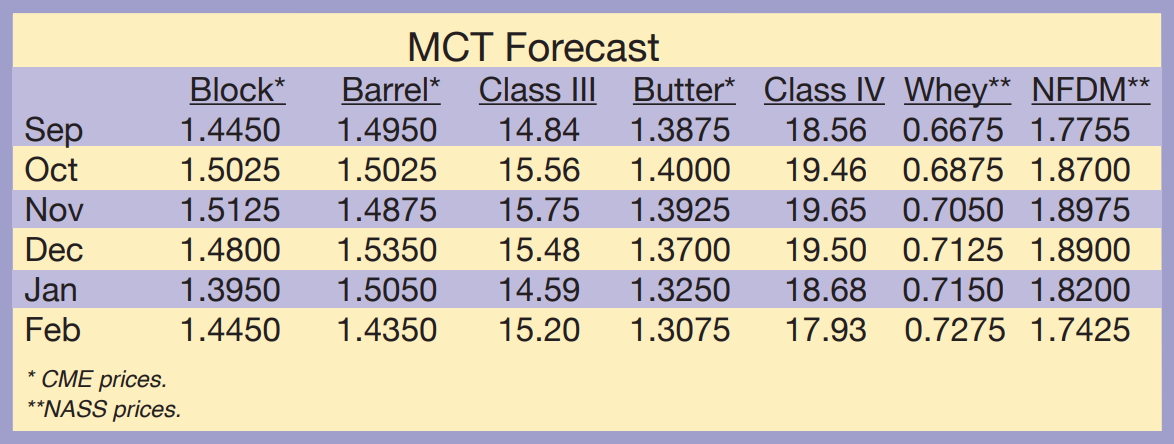
In late September, CME cheese and butter prices continued to trade in the $1.30s, while NFDM was selling for more than $2/lb. for the second time this year. These prices continue to reflect the ongoing sizeable gaps between butterfat- and protein-based products. Heading into the peak holiday-demand season, futures prices for cheese and butter contracts were trading well below their five-year averages. While that was not good news for dairy producers, the resulting long-standing competitive edge that U.S. dairy products have in export markets continues to move growing volumes of U.S. dairy to international markets. And that has helped support prices.
... most dairy travels far
truck running the 2,200 miles from Fresno, California, to Chicago, the cost is more than $6,500 for a dry van and nearly $7,950 for a refrigerated truck. Last week, these vehicles could have also incurred a fuel surcharge of roughly 97¢ per mile, which is the spread between $7.25/gal. diesel and a $1.425 base rate calculated at 6 miles per gallon, adding another $2,135 to the invoice. On a 43,000-pound load, the freight alone approaches 20¢ per pound for nonfat dry milk (NFDM) and 23¢ per pound for cheese or butter moving in a refrigerated truck.
Comparing that to shipping rates, a 40-foot container from the Port of Los Angeles to Tokyo could cost close to $4,000, or 6.6¢, per pound, assuming 60,000 lbs. per container, according to Freightos. It is now roughly three times more expensive to move West Coast dairy products to Chicago than to Asia. That is not a seasonal quirk. It is a structural inversion, and it could influence 2027 dairy markets from the farm gate to retail shelves.
At the processing level, higher fuel costs could profoundly affect product availability and basis next year. Everything from raw milk to finished product could stay closer to home to avoid costs that are expected to keep rising. The consequence is a widening basis in the Midwest and East, where local supply is in demand, and a softening basis in the West, where the haul to consumer markets is longest. The challenge is that the delivered cost, not the commodity price, determines demand.
Last year, nearly 38% of all U.S. cheese, 52% of butter, and 63% of NFDM came from western states. Most of that product traveled long distances. Making the trip costlier changes what sellers will accept to get their product to the closest, most transportation-efficient market. Intermodal and rail demand will rise as shippers seek relief, pushing those prices up as well but likely not as much as trucking.
Exports are the release valve. Most U.S. dairy product prices remain below those in the rest of the world, and as detailed above, ocean freight has risen by far less, in percentage terms, than domestic trucking. For a West Coast plant, a container to Asia is now the better move economically. If that holds into 2027, export volumes could expand for reasons that have little to do with global demand and much to do with what it costs to send product to Chicago.

Ken's Corner
by Ken Meyers President, MCT Dairies Inc.
At the farm level, the cost of diesel touches everything from harvesting crops and hauling milk to processor shipments bound for retailers and restaurants. A fuel surcharge of 81¢ per mile at the current national average diesel price applied to a 100-mile haul, adds more than 16¢ per hundredweight of milk to on-farm costs. That may look inconsequential but couple it with declining calf values and rising feed and fertilizer bills and it becomes one more line item whittling away earnings. If milk prices remain relatively flat, culling could increase just when milk is tightening and needed to meet expanded plant capacity.
Today’s high fuel costs could shape markets into 2027 and possibly even 2028. While milk and dairy product prices still provide a return to farms, basis tells a different story. Basis is not something producers can hedge against using futures markets.
For buyers, securing product closer to home becomes the obvious defense, but with the top-10 milk-production states accounting for 74% of 2026 milk production through August, buying locally is not a luxury all buyers have. That means, 2027 milk and dairy product prices could be more volatile than this year with large inequities across markets.
I'd like to receive the complimentary monthly MCT Compass!
"*" indicates required fields
The information collected is for MCT use only. We will not sell, distribute or lease your personal information to third parties unless we are required by law to do so.
The information contained in this newsletter is for general guidance only. It is not intended to constitute or substitute investment, consulting or other professional advice or services. The information presented is not an offer to buy or sell commodities. Compass accumulates then distributes opinions, comments and information from and based upon other public and reliable sources, but it cannot warrant or guarantee the accuracy of any of the data included in the newsletter. From time to time, MCT Dairies, Inc. may hold futures positions in commodities discussed in the newsletter. Always contact a registered financial advisor before making any decisions. MCT Dairies, Inc. shall not be held liable for any improper or incorrect use of the information contained in the Compass or for any decision made or action taken in reliance on the information in this newsletter. Reproduction with permission only.